Quick answer
Compare the actual proposals, duct condition and room-coverage needs. Ductless systems avoid conventional air-distribution losses, while central systems can be efficient when ducts are well designed and maintained. Installed prices and efficiency depend on the equipment and site.
Homes with no ducts (e.g., radiator or baseboard heat), leaky attic ducts, or chronic hot and cold rooms may benefit more from room-by-room control. Confirm the matched efficiency ratings and minimum capacities for each proposal.
Side-by-side engineering comparison
| Feature | Ductless mini-split heat pump | Central air conditioning / heat pump |
|---|---|---|
| Upfront cost (Existing usable ducts) | Quote-dependent; compare whole-home multi-zone proposals | Quote-dependent; compare direct central replacement proposals |
| Upfront cost (No existing ducts) | Quote-dependent; no major drywall demolition is typically required | Quote-dependent; ductwork retrofit scope can be substantial |
| Seasonal cooling efficiency (SEER2) | Model-specific; compare matched ratings | Model-specific; compare matched ratings |
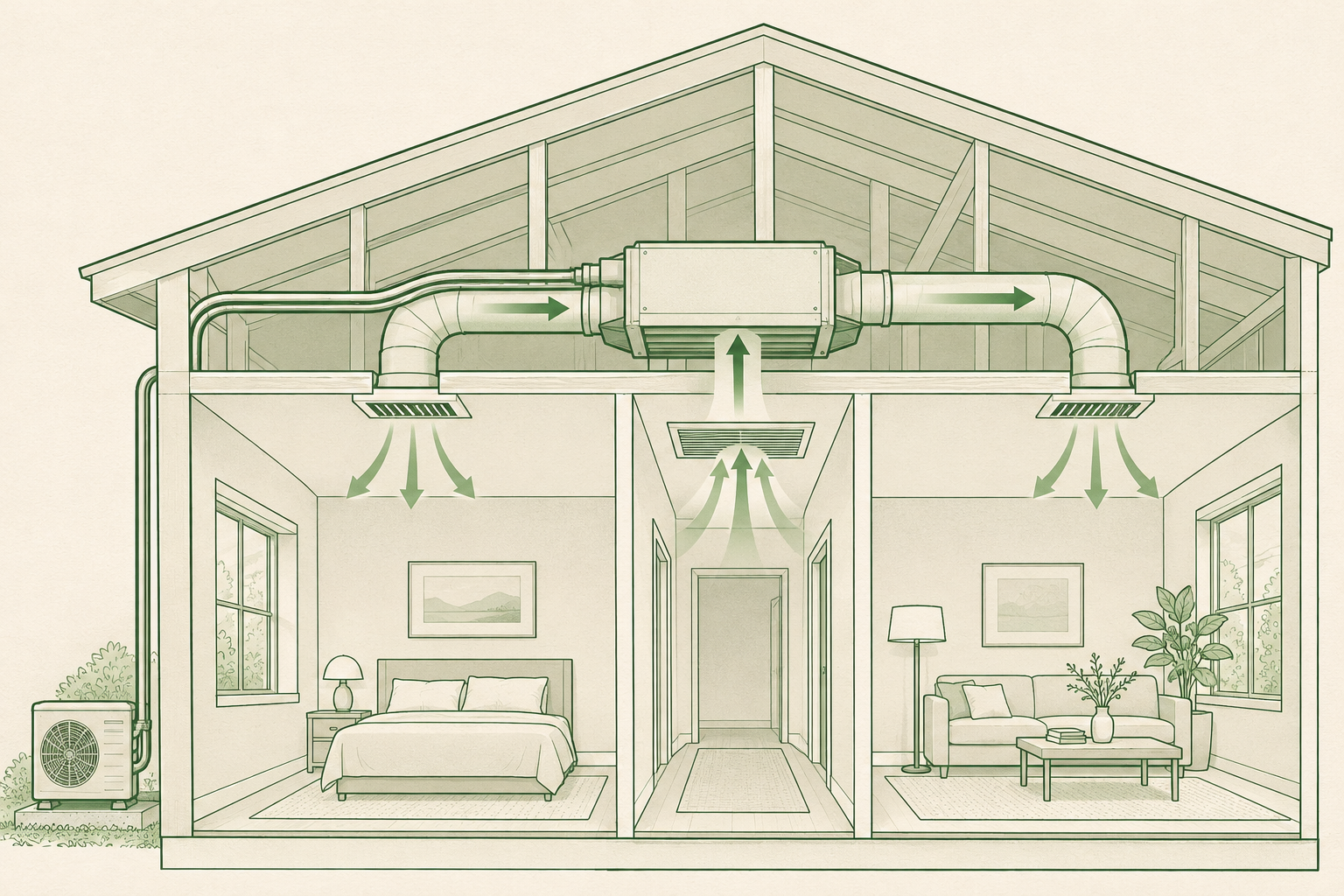
| Duct energy losses | None from ducts (refrigerant lines serve the room directly) | Depends on leakage, insulation and location; inspect or test the actual system |
| Room-by-room zoning | Standard: Each indoor head has its own thermostat | Single thermostat controls entire floor or house unless motorized dampers are added |
| Aesthetic appearance | Wall heads, floor consoles, or ceiling cassettes visible in each room | Discreet ceiling or floor supply registers |
| Filter maintenance | Clean indoor-head filters according to each model's operating manual; inspect more often in dusty conditions | Replace or clean central return filters per the equipment and filter manufacturer's instructions |
How duct condition affects system efficiency
Duct losses depend on leakage, insulation, location and design. Test or inspect the actual duct system before applying a percentage to a project estimate.
Ducts routed through unconditioned attics or crawlspaces can add heat gain or loss before air reaches the room. Ductless indoor heads avoid that distribution path, but the efficiency benefit should be evaluated against the specific installation and the central system's measured performance.
Financial scenarios: Replacement vs. new installation
- Scenario A: Existing central system with intact ducts. Replacing the central unit is often the simpler option when rooms are already reasonably balanced. Compare itemized proposals for both approaches.
- Scenario B: Older home with boiler or baseboard heat (no ducts). Adding central ductwork can require substantial finish work. A multi-zone mini-split may need fewer structural changes; compare the scope of each proposal.
- Scenario C: Hybrid solution. Keep existing central air for the main living area, and add a dedicated single-zone mini-split for a hard-to-condition space such as a bonus room, converted garage or addition.
Room-by-room zoning vs. single thermostat control
Central air conditioners use one central thermostat. When the thermostat in the hallway reaches its setpoint, the system turns off—even if an upstairs bedroom with western sun exposure is still warmer. Homeowners often try closing register dampers in unused rooms, which increases static pressure, causes duct air leaks, and can cause coil-icing problems.
With mini-splits, each room has independent temperature control. You can keep a home office at a different setpoint during the workday than an unused guest room, which can reduce energy use when rooms are not occupied.
When to choose central air vs. mini-splits
- Choose Central Air when: Your ductwork is tested and airtight, you want completely hidden equipment with zero wall clutter, and the matched central proposal meets your room-comfort needs.
- Choose Mini-Splits when: Your home has no existing ducts, you need different temperatures in different rooms, you are building an addition, or you want the matched equipment's cold-climate heating performance.
Questions to ask before choosing a system
“If we replace our central system, will you perform a duct leakage pressure test (duct blaster) and static pressure test first? If we switch to mini-splits, what is the itemized cost for dedicated heads versus keeping central ducts?”
Compare costs in our Mini-Split Installation Cost Guide and test monthly electricity costs with our Running-Cost Calculator.