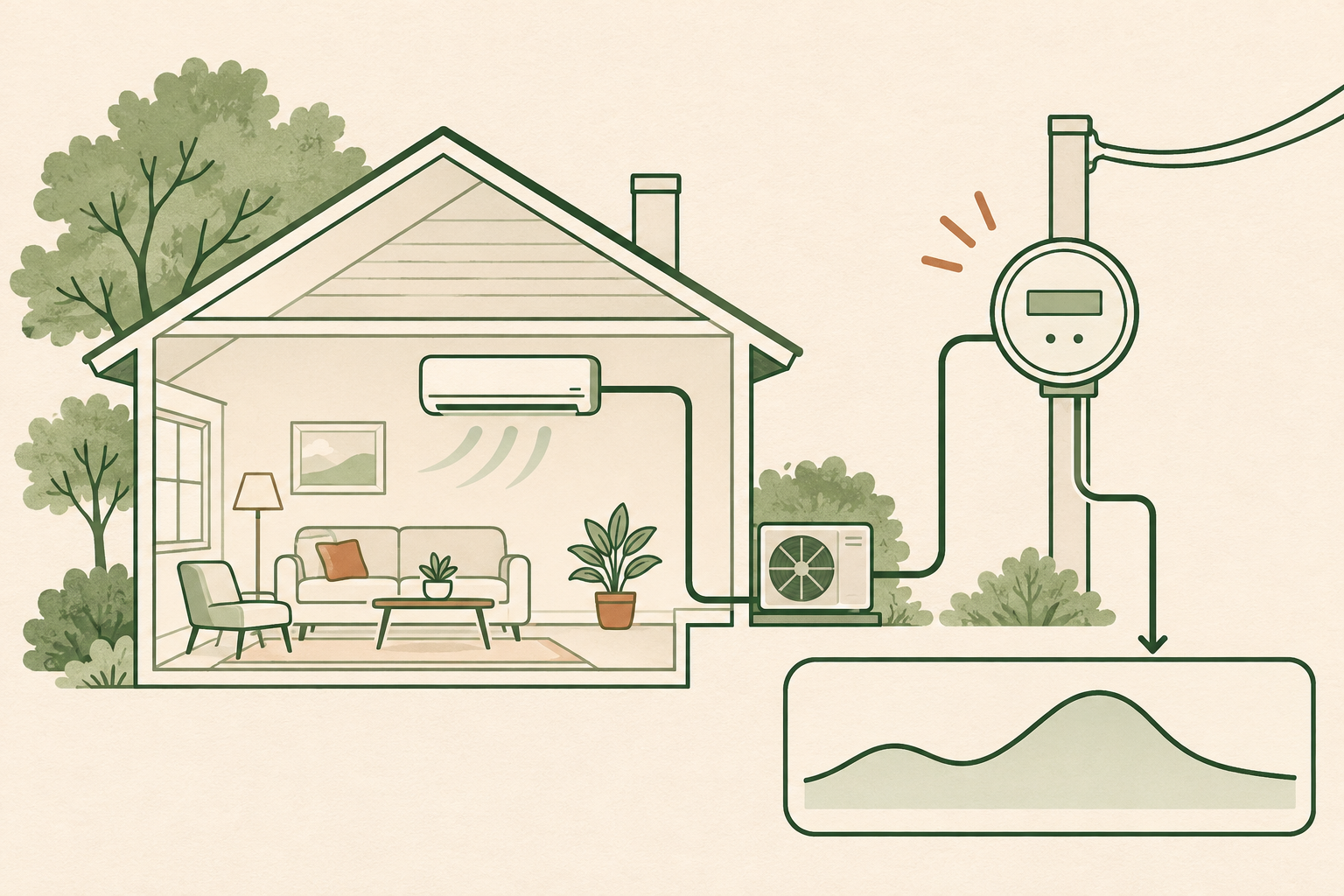
A bigger dollar bill is not a measurement of mini-split consumption. Compare kWh per day, rates and the rest of the household first.
Put the two bills beside each other
A higher bill after an installation is worth investigating, but timing alone does not establish a cause. Your electricity bill covers the whole property, not just the new system. Start with a small worksheet: billing start and end dates, number of days, total kWh, applicable usage charges, fixed fees and whether the meter reading was actual or estimated.
Keep dollar totals and energy totals in separate columns. One answers what you paid; the other records electricity used. If the billing period or price changed, dollars can rise without the same proportional change in daily consumption. This first check will not diagnose a fault, but it can prevent a misleading comparison.
Use the tariff that applies to your own account. EIA explicitly notes that it does not publish retail time-of-use rates or utility tariff data; its FAQ points readers toward utility schedules and other rate resources. A state average is not your personal tariff. See EIA's explanation.
A worked example: more dollars, the same daily kWh
Imagine an earlier bill showing 600 kWh over 30 days at a flat usage rate of $0.18/kWh. Its energy charge is $108, before fixed charges and taxes. Now imagine 660 kWh over 33 days at $0.21/kWh. The energy charge is $138.60.
The charge increased by $30.60, yet both periods average 20 kWh a day: 600 ÷ 30 = 20 and 660 ÷ 33 = 20. There is no increase in average daily whole-home electricity in this fictional example. The longer period and higher rate explain the difference in the simplified calculation.
Real tariffs can be more complicated. For time-of-use pricing, compare consumption and rates within each price period. Tiered rates and demand charges need their own treatment. Dividing your entire bill by total kWh can include fixed fees, so that result is not necessarily the marginal price of operating an appliance.
Write down what else changed
If daily kWh increased, create a dated list of other changes: occupancy, work-from-home hours, an electric vehicle, water heating, other heaters or an expanded conditioned area. Record outdoor conditions and thermostat habits too. These are investigation prompts, not a claim that any one change explains your bill.
If the mini-split replaced some use of another fuel, collect those bills as well. Electricity spending alone does not represent total household heating spending. Avoid claiming savings from one delivery invoice or one unusually mild month; purchase timing, weather and stored fuel can complicate a comparison.
A before-and-after bill is a useful starting point, but it is not a controlled experiment. Even similar calendar months can have different conditions. Label your conclusion honestly: “whole-home daily use increased” is a defensible observation; “the mini-split used the entire increase” is an additional claim requiring more evidence.
Measure the system when possible
If you have reliable system-level energy readings, record the measurement dates and what equipment the meter includes. If monitoring requires work on hardwired equipment, use a qualified professional. Do not open electrical panels or improvise plug-in monitoring for equipment that is not designed for it.
For an illustrative system reading of 180 kWh over 30 days at a flat $0.22/kWh, the usage cost is $39.60. Enter those values in our running-cost calculator. The result does not include fixed charges and does not tell you whether 180 kWh is appropriate for your home.
Without measured energy, an average-power scenario is only an assumption. Name it as such and try a range of inputs. Do not enter the unit's heating capacity as if it were electrical draw, or treat a maximum power rating as its average consumption.
Bring evidence to the installer
Prepare the bills, dates, operating settings, model numbers and any reliable energy logs. Describe whether comfort changed and when the concern began. Ask the installer to assess the equipment and controls against the intended design rather than asking for a universal “normal bill.”
Our electricity guide explains the units used here. This article is a recordkeeping method, not remote fault diagnosis. Burning smells, damaged wiring or other suspected electrical hazards require qualified attention; do not continue a monitoring experiment to obtain more data.
Editorial note: AI-assisted draft; not professionally reviewed. Sources checked November 16, 2026. Calculations and fictional examples are original illustrations, not measured outcomes. Methods and corrections policy.
Related guides
Why are my mini-split quotes so different? →